

Car Auction vs. Marketplace: What’s the Better Way for Dealers to Source?
For many years, car dealers have relied on auctions to buy inventory. They are fast, offer many choices, and seem like a good place to find deals. But in today’s digital world, are auctions really the best option anymore?
This blog questions that old habit. So, it will be a car auction vs. marketplace debate, which will explain why more smart dealers are now buying cars directly from private sellers on online marketplaces. These platforms often offer better-quality cars, higher profit margins, and faster sales.
Auctions can be useful for bulk or fleet purchases. But for higher profits and lower risk, buying from private sellers often works better. Many dealers wonder, “is buying cars at auction worth it?” The answer: it’s not always cheaper or easier and can sometimes cost more.
How Car Auctions Really Work: The Zero-Sum Game
The first critical misconception to shatter is the idea of “deals.” At a professional dealer auction, you are not bidding against misinformed consumers. You are competing in a room (or online) full of professionals armed with the same pricing tools and data you have.
The dynamic is simple:
- The “winner” is often the bidder who overestimates the vehicle’s reconditioning costs or underestimates market saturation.
- The only ways to “win” are through luck, another bidder’s misjudgment, or getting caught in emotional bidding.
- True, hidden gems are exceptionally rare and not a scalable sourcing strategy.
An auction is a zero-sum environment. For every car sold, one dealer’s gain is another’s lost opportunity. In dealer car sourcing, intense competition often eats into potential profit before the car even leaves the lot. Auctions are set up to get the most value for the seller, not to give buyers a bargain.
The Hidden Costs That Erode Auction Margins
The hammer price is only the start. With auction fees, a deal that looks good can end up just breaking even before any reconditioning. This is why many dealers consider car auctions vs private sellers—and find private sources often more profitable.
A typical auction purchase includes:
- Buyer’s Premium: A percentage fee on top of your winning bid.
- Transportation: Often a must, adding hundreds in cost and days in time.
- Arbitration & Storage Fees: If you find an issue and try to return the car, you face fees and lost time.
- Reconditioning Wild Cards: Without a thorough pre-purchase inspection, repair costs are an unknown.
Example: You “win” a car for $10,000. With a $500 buyer’s fee and $400 transport, your hard cost is already $10,900. Now add unexpected repairs discovered on your lot. That “deal” quickly approaches the retail wholesale price, leaving little to no spread.
Why Many Auction Cars Are There for a Reason
This is the most important point for dealers to understand about modern vehicle sourcing methods. Cars often end up at auction because the selling dealer doesn’t want them on their own lot.
Think about it: Would a dealer wholesale a clean, high-demand, perfectly maintained vehicle for less money, or retail it themselves for maximum profit? The auction lane becomes a channel for:
- Mechanical or cosmetic issues are too costly for the selling dealer to fix.
- Title problems (branded, salvage, lemon law).
- Poor vehicle history (multiple owners, accident history, gaps in service).
- Undesirable specs or colors that are hard to retail.
While auctions have rules to settle disputes, the process is slow and tricky. Basically, buying cars at auction means you are taking on another dealer’s problem or their lower-quality inventory.
Marketplaces & Private-Party Sourcing Explained: A Different Ecosystem
Unlike auctions, marketplace vehicle sourcing lets you buy directly from regular car owners on platforms like Facebook Marketplace, Craigslist, or dealer apps. The sellers aren’t professional dealers.
These owners typically:
- Have maintained the vehicle for personal use.
- Know the full history—they lived it.
- Drove the car daily, meaning issues are often known and disclosed.
- Are emotionally or financially motivated to sell quickly.
The vehicles themselves are often cleaner, in better running condition, and have spent years in a garage, not a rental fleet. Most importantly, you can conduct a full, in-person inspection and a test drive before committing a dollar. This drastically reduces the “unknown” factor.
Where the Largest Spreads Actually Exist
The biggest margins aren’t found in a bidding war against peers. They are found in information asymmetry and mispricing in the private market.
Private sellers often:
- Don’t understand the current market value. They price based on their loan payoff, emotional attachment, or an outdated KBB guide.
- Price for a quick sale due to life events (moving, new baby, need cash).
- Are not optimized by algorithms. Their price is static, not driven up by competitive bidding.
This creates real profit opportunities. A dealer with up-to-date market data can spot a vehicle priced 20–30% below retail, negotiate a fair deal, and acquire a vetted asset. This is the best way for dealers to source cars and scale profits effectively.
Speed Is the Main Signal in Private Party Markets
In private-party car buying, speed beats capital. The best deals are often gone in hours, not days.
Your process is your advantage:
- Automated Alerts: Use tools to get instant notifications on new listings.
- First Contact: Reach out within minutes, not hours.
- Immediate Inspection: Schedule a look the same day.
- Same-Day Close: Have funds ready to transact on the spot.
A seller with three offers in an hour will almost always take the first serious, cash-ready buyer—even at a slightly lower price. This highlights the private party vehicle sourcing advantages, rewarding the efficient, organized dealer rather than just the one with the deepest pockets.
Faster Inventory Turn & Lower Risk
By sourcing directly from private sellers, dealers can avoid many risks of buying cars at auction, such as hidden damage, inflated fees, or competitive bidding that erodes profit. This approach keeps inventory moving quickly while minimizing unexpected costs.
The benefits compound after purchase:
- Faster to Lot: Acquired locally, the car can be in your reconditioning bay the same day.
- Fewer Reconditioning Surprises: A thorough pre-purchase inspection means your shop quote is accurate. No auction arbitrations, no hidden damage.
- Higher Sell-Through Velocity: Cleaner cars with better histories sell faster to consumers.
- Improved Cash Flow: The entire cycle—from sourcing to retail sale—is accelerated, boosting your return on investment.
Car Auction vs Marketplace: Side-by-Side Summary
Feature | Car Auctions | Marketplaces / Private Party |
Competition | High (other professional dealers) | Low (other retail buyers) |
Acquisition Cost | Hammer price + high fees (5-10%+) | Negotiated price + minimal fees |
Vehicle Condition | Higher risk, “as-is” often | Generally cleaner, better maintained |
Inspection | Limited (walk-around only) | Comprehensive (test drive, lift, scan) |
Pricing Dynamic | Optimized by bidding, often inflated | Often mispriced, emotional seller |
Title & History Risk | Higher (title flood, issues) | Lower (often clean title, single-owner) |
Inventory Cycle Speed | Slower (transport, arbitration risk) | Faster (local, immediate possession) |
Scalable Profit Potential | Low (margins competed away) | High (true arbitrage opportunities) |
Frequently Asked Questions (FAQs)
Rarely. The final all-in cost at auction (price + fees + transport + higher reconditioning) often meets or exceeds a clean private-party purchase price, with significantly more risk.
For volume sourcing of specific fleet vehicles, convenience, and access to certain channels (like manufacturer leases). It’s a tool for inventory fill-in, not necessarily for primary profit sourcing.
It carries different risks—primarily title fraud or misrepresentation. However, these are mitigated by using secure payment methods, running a title check before payment (using a service like CARFAX or AutoCheck), and conducting a thorough pre-purchase inspection. The mechanical risk is far lower than with an “as-is” auction buy.
The best deals move in hours. Having a system for instant alerts, immediate contact, and same-day inspection/funding is critical to success in this space.
Private-party sourcing consistently offers the potential for better gross margins. You are avoiding bidding wars and acquiring vehicles that were fundamentally underpriced relative to the retail market, rather than buying at a price already optimized by a professional seller.
Final Thoughts: It’s Time to Rethink Your Pipeline
For dealers, the question isn’t car auction vs.marketplace anymore. It’s about embracing the superior model: private-party sourcing. Here, speed and insight beat deep pockets, delivering better vehicles with stronger margins.
The key is execution. This is where specialized platforms like Swoopa are essential. Built for dealers, Swoopa automates the hunt—delivering real-time alerts on undervalued vehicles and streamlining the entire buy—so you can acquire the best inventory before the competition even sees it.
Stop competing in the narrow, high-cost auction lane. Win in the vast private market with the right tools.
You May Like
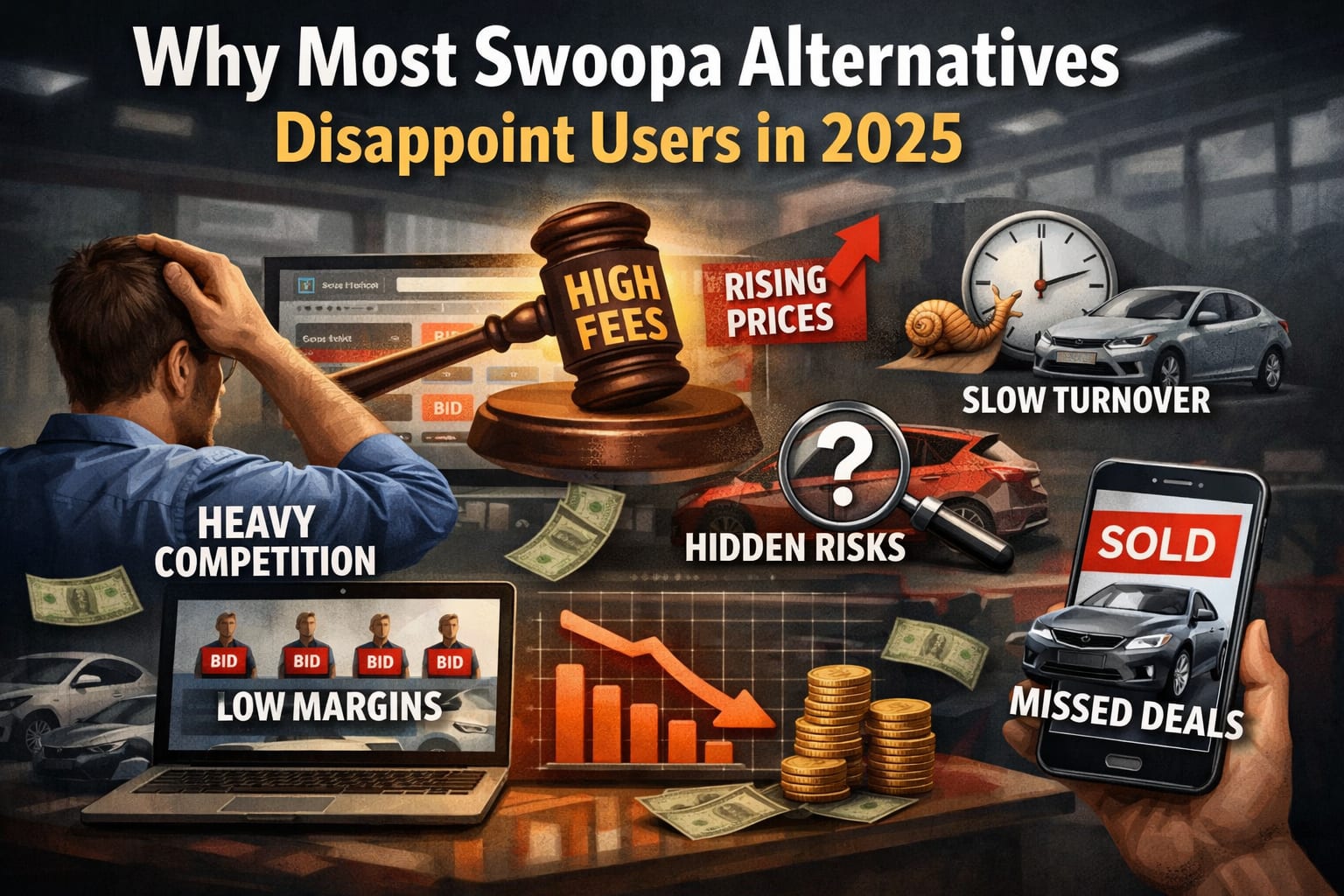
Why Most Swoopa Alternatives Disappoint Users in 2025
In 2025, online flipping has evolved from a casual side hustle into a full-blown digital economy. It’s a movement where everyday people are turning used items, clearance deals, and even digital
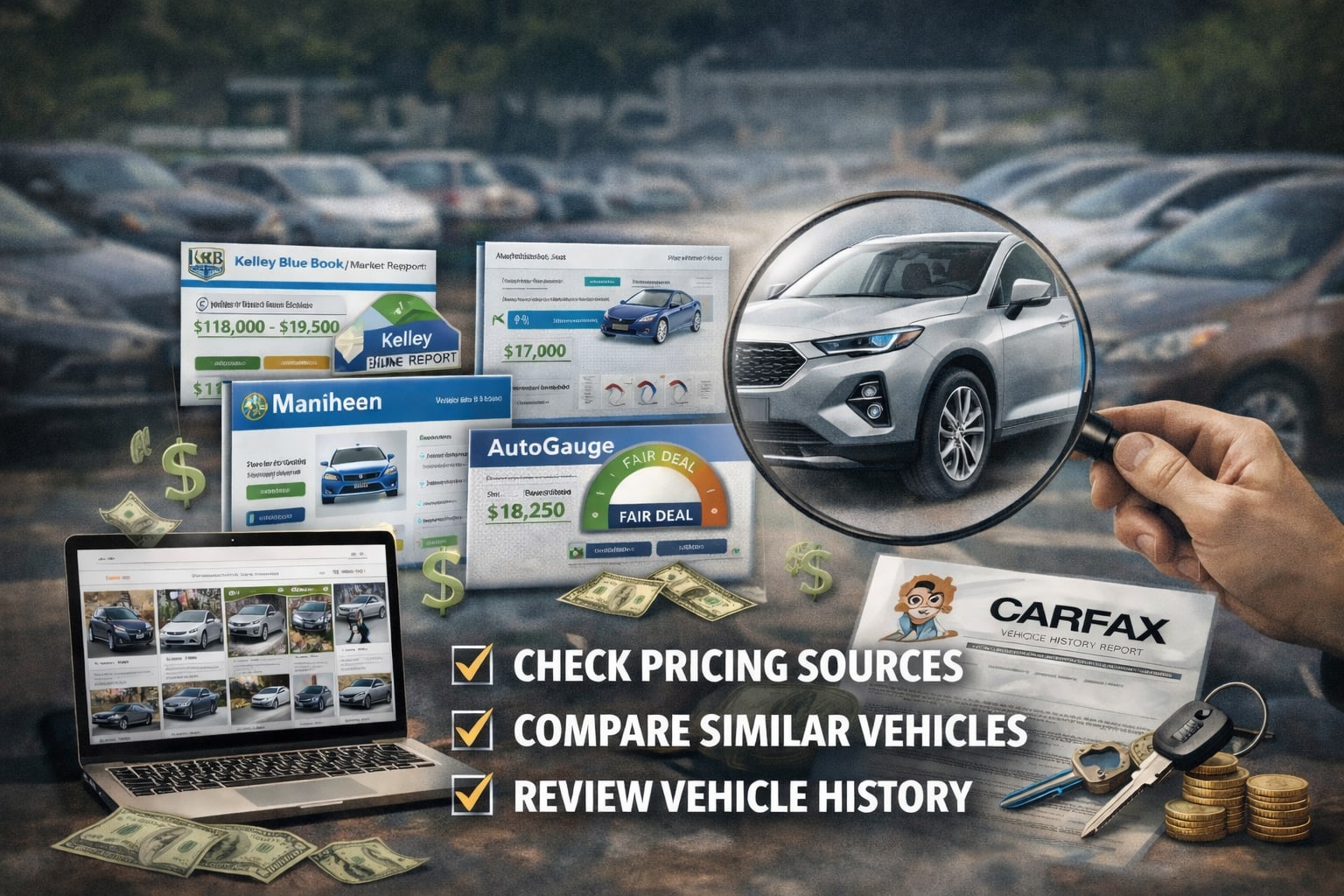
How to Evaluate a Vehicle’s True Value Before Buying
In 2025, online flipping has evolved from a casual side hustle into a full-blown digital economy. It’s a movement where everyday people are turning used items, clearance deals, and even digital
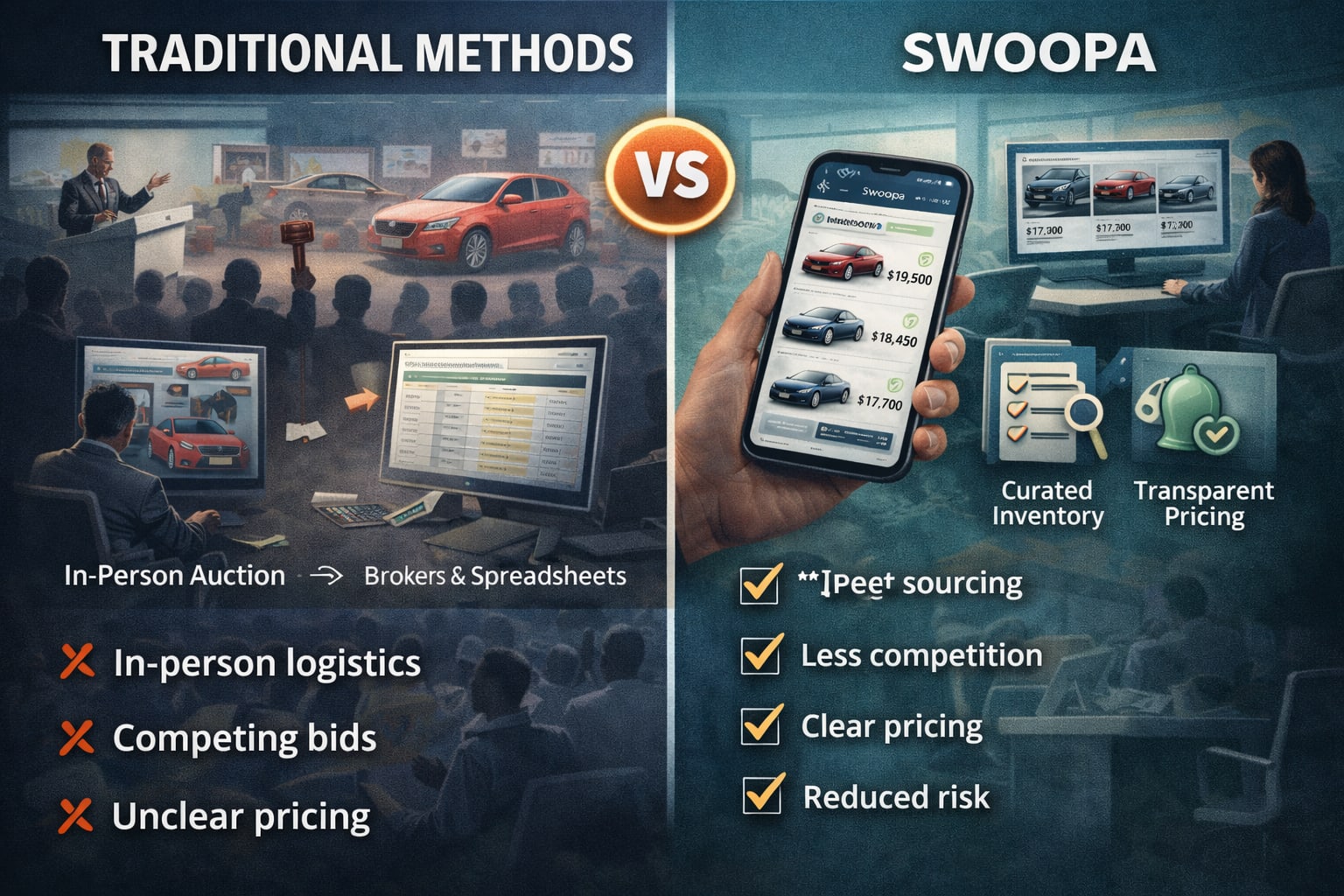
Swoopa vs Other Alternatives: A Smarter Way to Source Vehicles
In 2025, online flipping has evolved from a casual side hustle into a full-blown digital economy. It’s a movement where everyday people are turning used items, clearance deals, and even digital